
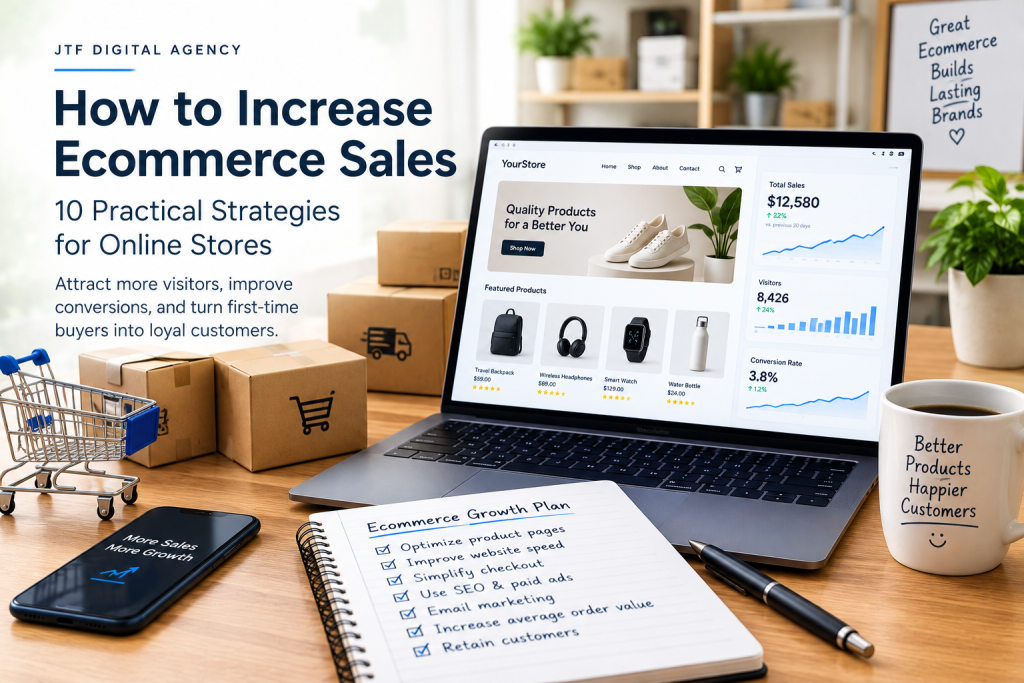
Getting people to visit your online store is only half the challenge. The real objective is to turn those visits into purchases and encourage customers to return.
An ecommerce business can have attractive products, an active social media presence, and a steady stream of visitors but still struggle to generate consistent sales. The cause may be weak product descriptions, unexpected shipping costs, a confusing checkout process, poor targeting, or a lack of follow-up.
The good news is that increasing ecommerce sales does not always require spending more on advertising. Improving the experience for visitors who already reach your store can also create opportunities for growth.
Here are ten practical strategies to help your ecommerce business attract shoppers, improve conversions, and build stronger customer relationships.
1. Optimize Your Product Pages
Your product page needs to answer the questions a shopper would normally ask before making a purchase.
Visitors should understand what the product does, what makes it useful, what it looks like, and whether it meets their needs.
Strong product pages typically include:
- Clear, high-quality product images.
- Descriptive product titles.
- Benefit-focused descriptions.
- Accurate pricing, sizing, and specifications.
- Clear information about shipping, delivery, and returns.
- A prominent add-to-cart button.
Avoid descriptions that simply repeat generic supplier information. Explain how the product fits into the customer’s life and what makes it worth considering.
For clothing stores, include size guides, fabric details, and useful fit information. For electronics, explain compatibility, specifications, and important limitations.
The more clearly you communicate product value, the easier it becomes for shoppers to make informed decisions.
2. Improve Website Speed and Mobile Usability
Many customers browse online stores using mobile devices. If your pages load slowly, buttons are difficult to tap, or product information is hard to read, visitors may leave before completing a purchase.
Review your store on different screen sizes and check whether the main shopping tasks are easy to complete.
Focus on optimizing oversized images, reducing unnecessary scripts, removing distracting pop-ups, and simplifying navigation.
Tools such as Google PageSpeed Insights can help identify performance issues and suggest improvements.
Remember that website speed is only one part of the experience. A fast store must also be easy to understand, navigate, and purchase from.
3. Simplify the Checkout Process
A complicated checkout can prevent interested shoppers from completing their orders.
Review your checkout and remove unnecessary friction wherever possible.
Consider offering guest checkout, displaying shipping costs early, reducing unnecessary form fields, and providing clear payment and delivery information.
Make error messages understandable and ensure customers can easily correct mistakes. Where appropriate, offer familiar and secure payment methods that are available to your target market.
Track how many shoppers add products to their carts and how many complete their purchases. A large difference between these numbers may indicate an opportunity to investigate checkout friction, pricing concerns, delivery costs, or payment problems.
4. Use Search Engine Optimization to Attract Buyers
SEO can help your store attract people searching for products you sell.
Start with keyword research. Identify how potential customers describe your products and what they want to know before purchasing.
Optimize relevant product pages, collection pages, page titles, meta descriptions, headings, and image alternative text. Create helpful content that answers questions related to your product category.
For example, an outdoor equipment store might publish a guide comparing different types of hiking backpacks. The article can link naturally to relevant product collections, helping readers move from research to shopping.
Use internal links to connect related products, buying guides, and category pages. This helps visitors discover relevant items while making the relationship between your pages clearer.
Google’s SEO Starter Guide offers practical advice on helping search engines understand your website.
5. Create Better Product Photography and Video
Customers cannot physically examine products before ordering online, so visual presentation plays an important role in helping them evaluate what they are buying.
Use clear images that accurately represent the product. Show multiple angles, relevant details, and the product in use where appropriate.
Short demonstration videos can explain features that static images cannot communicate easily. Fashion brands may show how an item fits, while homeware stores can demonstrate a product’s dimensions or practical use.
Keep product visuals consistent with your brand, but do not sacrifice accuracy for aesthetics. Misleading images can damage trust and contribute to returns or complaints.
6. Build Trust Before Asking for a Purchase
Online shoppers need reasons to believe that a store is legitimate and that their order will be handled properly.
Build trust by making important information easy to find.
Include clear contact details, delivery policies, return and refund information, privacy information, and accurate product descriptions. Use genuine reviews and testimonials where available.
Avoid fake countdown timers, fabricated reviews, misleading discounts, or security badges that do not reflect actual protections.
A trustworthy store communicates openly, sets realistic expectations, and makes it easy for customers to get help.
7. Use Email Marketing to Recover Lost Sales
Some visitors will add products to their carts but leave without buying. Others will browse, compare options, or decide to return later.
Email marketing can help you follow up with people who have consented to receive relevant communications.
Useful ecommerce email flows include:
- Welcome emails for new subscribers.
- Abandoned-cart reminders.
- Post-purchase instructions and support.
- Product recommendations based on relevant interests.
- Re-engagement campaigns for inactive customers.
Abandoned-cart messages should be helpful rather than aggressive. Remind customers what they were considering, answer common questions, and provide a direct path back to checkout.
Where appropriate, test incentives such as free shipping or a discount, but avoid training every customer to wait for a promotion.
8. Use Paid Advertising to Reach Relevant Shoppers
Paid advertising can introduce products to people searching for them or audiences who may be interested.
Depending on your store and market, you could consider Google Shopping, paid search, Meta advertising, TikTok advertising, or other relevant platforms.
Before scaling campaigns, ensure that your product pages, tracking, checkout, and fulfilment processes are working properly.
Measure purchases and revenue rather than relying exclusively on impressions and clicks. Calculate acquisition costs and compare them with your margins and customer value.
For example, a product generating £50 in revenue does not necessarily produce £50 in profit. Product costs, shipping, transaction fees, discounts, returns, and advertising expenses all affect the outcome.
9. Increase Average Order Value
Increasing sales does not always mean acquiring more customers. You may also be able to increase the value of each order by helping shoppers discover relevant products.
Strategies include:
- Bundling complementary products.
- Recommending related accessories.
- Offering useful product combinations.
- Introducing quantity discounts where margins allow.
- Providing free-shipping thresholds that make financial sense.
For example, a skincare store could offer a cleanser and moisturizer bundle instead of selling each item separately.
Recommendations should be relevant to the customer’s needs. Avoid overwhelming shoppers with unrelated offers or making the checkout experience unnecessarily complicated.
10. Encourage Repeat Purchases
Existing customers can provide opportunities for sustainable growth, especially when your products naturally support repeat purchases.
After an order, provide useful updates, clear delivery information, and responsive customer support. Follow up with relevant product education and recommendations when appropriate.
You can also develop loyalty programs, subscriber benefits, or replenishment reminders for products customers purchase regularly.
Monitor repeat purchase rates, customer lifetime value, and customer feedback. These measures help you understand whether your store is building lasting relationships rather than relying exclusively on new customer acquisition.
How to Identify What Is Preventing Your Store From Growing
Before implementing every strategy, review your ecommerce funnel.
| What you observe | What to investigate |
|---|---|
| Few visitors | SEO, audience targeting, content distribution, and advertising |
| Visitors but few product views | Navigation, product discovery, and collection pages |
| Product views but few cart additions | Pricing, product information, images, and perceived value |
| Many carts but few purchases | Shipping costs, checkout friction, payment options, and trust |
| Sales but weak profitability | Margins, discounts, acquisition costs, and fulfilment expenses |
| Few repeat purchases | Product experience, customer support, retention campaigns, and relevance |
These patterns are diagnostic clues, not proof of a particular problem. Use analytics, customer feedback, and testing to determine what is actually happening.
How JTF Digital Agency Can Help Your Ecommerce Business
Improving ecommerce performance often requires more than a single change. Your website, product pages, traffic sources, email marketing, customer data, and follow-up processes all influence the customer experience.
JTF Digital Agency offers digital solutions including website design, search engine services, email marketing, sales funnel development, and automation. These services can support businesses looking to improve their online presence and customer journey.
The most effective starting point is to identify the biggest barrier to profitable growth, then prioritize improvements according to their likely impact and implementation cost.
Final Thoughts
Increasing ecommerce sales is about helping the right customers discover your products, giving them confidence to buy, and making the shopping experience straightforward.
Start by reviewing your store’s biggest weaknesses. Improve your product pages and checkout, measure where customers drop off, and build a marketing system that supports both new and returning buyers.
Want to improve your online store’s performance? Visit JTF Digital Agency to explore website, marketing, and automation solutions for your business.